

تفاصيل الاتصال:
+86 17852488518

Product Overview
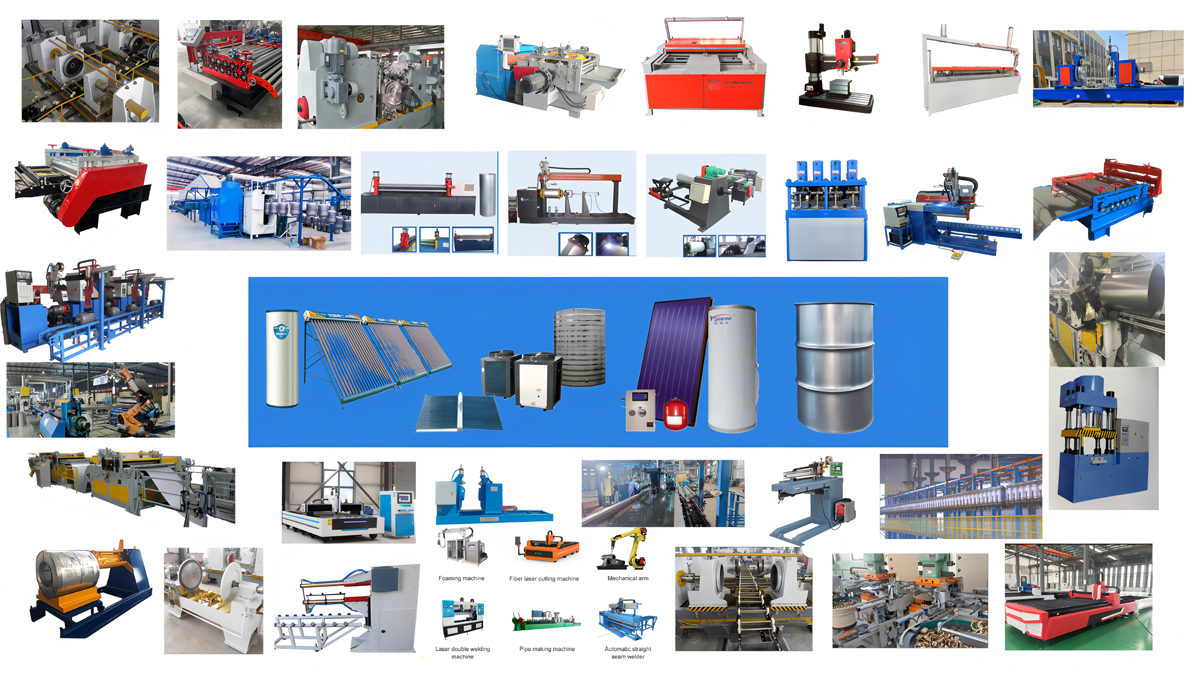
The Automatic Steel Drum Glue Applying Machine is an auxiliary equipment specially designed for Steel Drum Production Lines, mainly used for applying sealing adhesive to drum edges, covers, and sealing areas to improve airtightness and prevent leakage. It is suitable for manufacturing 200L (55-gallon) steel drums, open-head drums, closed-head drums, and 10–60L small metal containers. The machine adopts an automatic glue dispensing system, precision coating mechanism, PLC control technology, and adjustable operating parameters to ensure uniform glue application, accurate positioning, and stable production performance. It supports different types of sealing adhesives and can be adjusted according to various drum sizes, production speeds, and process requirements. With advantages of high coating accuracy, low glue consumption, easy operation, reliable performance, and simple maintenance, the equipment helps improve sealing quality and production efficiency. The glue applying machine can be integrated with drum forming machines, seam welding machines, flanging machines, and seaming machines to build a complete automatic steel drum manufacturing line. It is widely used in chemical, petroleum, lubricant, paint, coating, food, and industrial packaging industries. Tai'an Lishen Machinery Technology Co., Ltd. provides customized glue application solutions, equipment integration, installation support, and technical services according to customers' production needs.


You know what surprises most people about steel drums? It's not the steel, the welding, or the heavy-duty forming. It's the
glue. That bead of sealant applied to the lid before seaming is what actually makes the drum leak-proof. And the machine
that puts it there? That's your Steel Drum Glue Applicator. Without it, even a perfect double seam can have microscopic gaps
that let liquids seep through. And once your drum starts leaking, everything else you did right doesn't matter.
In the steel drum industry, we use a few different terms for this machine: glue applicator, Sealant Injection Machine, or
sometimes just "the glue gun." Whatever you call it, its job is the same: apply a precise bead of sealing compound to the lid
curl before the seaming rollers do their work. When the double seam is formed, that sealant fills every tiny gap, creating a
truly leak-proof joint.
There are two main approaches to applying sealant: pre-curl injection and in-seaming injection. Pre-curl injection applies
the glue during the lid curling stage, followed by hot air drying to create what's called a "dry gasket." In-seaming injection
sprays the sealant at the exact moment the seaming rollers engage, resulting in a "wet seal" that fills the entire seam. Both
methods work, but I've seen factories get more consistent results with the wet seal approach because the compound is still
wet when it gets crushed between the steel layers, so it flows into every gap. The dry seal method can be cleaner to run, but
you need to make sure your drying setup is spot-on.
Here's the thing about glue applicators that a lot of manufacturers overlook. The sealant itself needs to be applied in exactly
the right amount. Too little, and you'll have gaps. Too much, and you'll have sealant squeezing out of the seam, which looks
messy and can interfere with painting. A good applicator uses a metering system—typically a gear pump or a piston
pump—to deliver a precise, consistent amount of sealant on every lid. The gear pump maintains constant pressure to the
glue heads, which is critical for consistent bead size. Some systems even use servo motors to control the pump speed based
on the line speed, so if your production speed varies, the glue application automatically adjusts to match.
When you're shopping for a glue applicator, look for a machine that's easy to clean. Sealant compounds are sticky, and they
tend to dry out and harden if you don't flush the system regularly. A machine with a self-cleaning nozzle system that purges
the lines at the end of each shift can save you a huge amount of maintenance time. Some applicators are designed with
quick-release fittings and tool-less disassembly, so your operator can clean the nozzles in minutes instead of hours.
Another thing to pay attention to is the positioning system. The applicator needs to apply the sealant in exactly the right
place on the lid curl. If it's off by even a few millimeters, the sealant won't be in the right spot when the seam is formed, and
you'll get leaks. Modern applicators use precision stops or sensors to ensure the nozzle is correctly positioned every time.
One more practical tip: always keep a supply of spare nozzles on hand. Nozzles wear out and clog over time, and when they
do, they spray sealant unevenly. Instead of trying to clean a clogged nozzle and losing production time, swap it out for a
fresh one. You can clean the used ones later and cycle them back in.
At the end of the day, your steel drum glue applicator may seem like a small piece of the puzzle. But in a production line
where every drum has to be leak-proof, a reliable glue system is a reliable reputation.


يستخدم هذا الموقع ملفات تعريف الارتباط لضمان حصولك على أفضل تجربة على موقعنا.


 English
 Español
 Pусский
 Français



 هاتف
هاتف