

تفاصيل الاتصال:
+86 17852488518

Product Overview
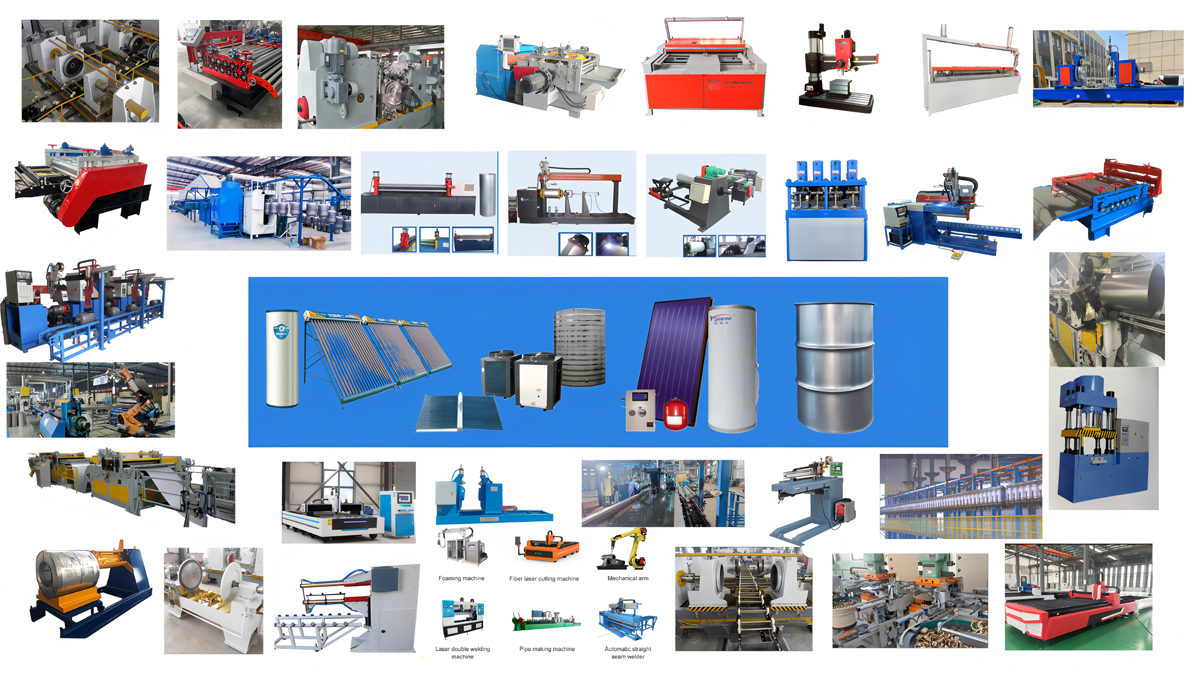
The Automatic Steel Drum Production Line is a complete manufacturing system designed for producing 200L (55-gallon) steel drums, closed-head drums, open-head drums, and 10–60L small metal containers. The production line integrates multiple processes, including steel coil decoiling, leveling, cutting, punching, drum body forming, longitudinal seam welding, flanging, rolling, seaming, leak testing, and automatic conveying. Equipped with advanced PLC control technology, high-precision transmission components, and intelligent automation systems, it ensures stable operation, high production efficiency, and consistent product quality. The line is suitable for processing different steel sheet thicknesses and drum specifications according to customer requirements. It is widely used in chemical, petroleum, lubricant, paint, food, beverage, and industrial packaging industries. Tai'an Lishen Machinery Technology Co., Ltd. provides customized turnkey solutions, including production line design, factory layout planning, equipment installation, technical training, and after-sales support. With reliable performance, energy-saving operation, and flexible configuration options, the steel drum production line helps global manufacturers achieve efficient and intelligent metal packaging production.


When I first started working with steel drum manufacturers, I thought the magic happened in the welding machine. Then I
realized I was looking at it wrong. The real magic isn't in any single piece of equipment—it's in how they all work together.
And that's exactly what a Steel Drum Production Line is: a carefully choreographed sequence of machines that transforms a
massive steel coil into finished, stackable containers ready for shipping.
The whole process starts at the front of the line with the decoiler and leveler . The steel coil—sometimes weighing up to 10
tons—gets loaded onto an uncoiling unit, where it's fed through a leveler that flattens the curved sheet into a perfectly flat strip. A servo motor controls the feed length with cutting precision down to ±0.5mm. From there, the sheet moves into the body forming section: a rolling machine bends the flat sheet into a cylinder, a seam welder joins the overlapping edges into a continuous weld, and then flanging, beading, and corrugating machines add the stiffness and structure .
On the other side of the line, separate equipment is busy making the drum's top and bottom lids. A 160-ton press forms the
lids from steel sheets, and the finished lids move toward the seamer where they'll be attached to the drum body . Then
comes the sealing station—a double seamer that rolls the lid and body edges together, creating that tight, leak-proof joint.
Modern steel drum production lines are all about automation. A fully automatic line uses PLC controls and hydraulic drives
to coordinate every step, so you're not relying on manual handling to move drums between stations . Some high-speed lines
now run at 10 drums per minute or more . At that speed, one operator can oversee an entire line that used to require a crew
of 20 or more .
If you're choosing between automation levels, here's a practical rule: semi-automatic lines still need an operator at each
station to load and unload drums. Fully automatic lines use conveyors and transfer systems to move drums from one
machine to the next without human touch. I've seen factories go from 15 to 5 operators per shift just by upgrading from
manual to fully automatic—and the quality actually improves because there's less human error .
One more thing I always mention: look for a line with good integration between sections. The most common bottleneck I
see is where the welding section and the flanging section don't sync up. A buffer zone between them lets the faster machine
keep running while the slower one catches up, and that simple design choice can boost your overall throughput by 20
percent without buying any new machines.
Your steel drum production line is more than a collection of machines—it's a system. When each part works together, you
get consistent quality, lower labor costs, and the confidence to take on big orders. And in this industry, that's the kind of
confidence that builds a reputation.
 RELATED


يستخدم هذا الموقع ملفات تعريف الارتباط لضمان حصولك على أفضل تجربة على موقعنا.


 English
 Español
 Pусский
 Français



 هاتف
هاتف