

تفاصيل الاتصال:
+86 17852488518

Product Overview
This double-head straight seam welding machine is a high-efficiency resistance welding device specifically designed for
longitudinal straight seam welding of steel drums in Steel Drum Production Lines. It employs a dual-welding-head synchronous
working structure, significantly increasing welding capacity. The equipment is equipped with two independent welding units,
respectively arranged at both ends of the crossbeam. Synchronous or independent welding is achieved through a variable
frequency motor drive, while PLC controls the welding length and action flow. Pneumatic clamping ensures precise
positioning.
Main parameters: Applicable workpiece thickness 0.5~6mm, effective welding length ≤1500mm, workpiece diameter range
Φ130~1000mm; slide plate movement speed 100~2500mm/min, walking accuracy 0.2mm; welding torch pneumatic lifting
stroke 100mm, manual fine-tuning distance 60mm on each side; equipment dimensions 2000×1100×1800mm. The welding
process is ensured by displacement sensors to guarantee synchronous welding of both heads, and a water cooling system
prevents overheating, ensuring a smooth, leak-free weld. It is a core piece of equipment for steel drum and container
manufacturers to improve straight seam welding efficiency.
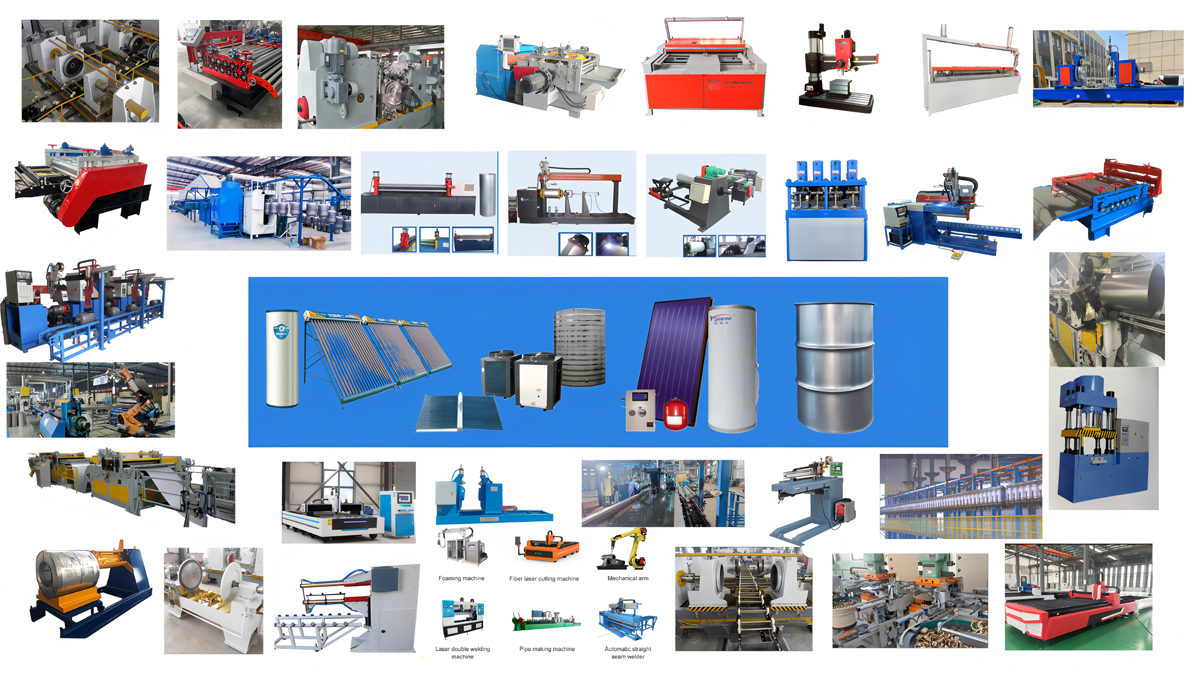


I’ll never forget the day a steel drum factory manager showed me his production bottleneck. He had a single-head seam
welder running flat out, but it couldn’t keep up with the rolling and flanging stations ahead of it. Drums were piling up
between operations, and his output was stuck at about 300 drums per shift. He asked me, “Do I really need to buy a whole
second welding line, or is there a smarter way?” That’s when I told him about double-head seam welders.
The idea is simple: instead of one welding head working on one drum at a time, a double-head machine has two welding
heads that can work simultaneously. In a Steel Drum Production Line, this usually means two independent welding stations
mounted on the same frame, each capable of welding the longitudinal seam of a drum body. One operator can run both
stations, which effectively doubles your welding output without doubling your labor cost or floor space .
Now, here’s where it gets interesting. Some double-head welders aren’t just two copies of the same machine—they’re
designed with different welding heads for different tasks. For instance, one head might be set up for standard resistance
seam welding of drum bodies, while the other handles different material thicknesses or even different drum sizes. That kind
of flexibility is gold in a job shop where you’re running mixed batches. I’ve seen factories use a double-head welder to run
200L drums on one side and 210L drums on the other, all in the same shift.
The technical side of a double-head seam welder is similar to a single-head model: electrode wheels deliver current and
pressure to create a continuous weld along the overlapped seam . The drum body passes between the electrode wheels,
and the resistance heat melts the steel at the faying surfaces, forming a durable, leak-proof joint. A good double-head
machine will have independent parameter controls for each head—welding current, electrode pressure, and welding speed
can all be adjusted separately . That way, if you’re welding different steel thicknesses on each head, you can dial in the right
settings without compromising one side for the other.
So how do you choose between a single-head and a double-head seam welder? Ask yourself two questions. First, what’s
your target production volume? If you’re planning to run more than 500 drums per shift, a double-head machine will help
you hit that number without adding a second shift. Second, how much variety do you run? If you’re constantly switching
between different drum sizes or steel gauges, the independent controls on a double-head machine give you the flexibility to
handle mixed production runs efficiently.
From a maintenance perspective, double-head welders aren’t twice the work of a single-head machine. The electrode
wheels wear at roughly the same rate on both heads, so you can schedule maintenance for both at the same time. And
because the machine has a rigid welded frame, the alignment stays consistent across both stations, reducing the chance of
drift.
One practical tip I always share: when you’re setting up a double-head welder, take the time to verify that both welding
heads are producing identical weld quality before you push production. Run a sample drum through each head and cut the
weld seam open to inspect the penetration and overlap. If one head is slightly out of alignment, you’ll catch it before it
becomes a batch rejection.
At the end of the day, a double-head seam welder is the answer to a common problem: how to increase welding capacity
without adding a whole second line. It’s the kind of investment that pays for itself in throughput gains and labor savings,
and it gives you the flexibility to handle mixed production runs with confidence.


يستخدم هذا الموقع ملفات تعريف الارتباط لضمان حصولك على أفضل تجربة على موقعنا.


 English
 Español
 Pусский
 Français



 هاتف
هاتف