

تفاصيل الاتصال:
+86 17852488518

Product Overview
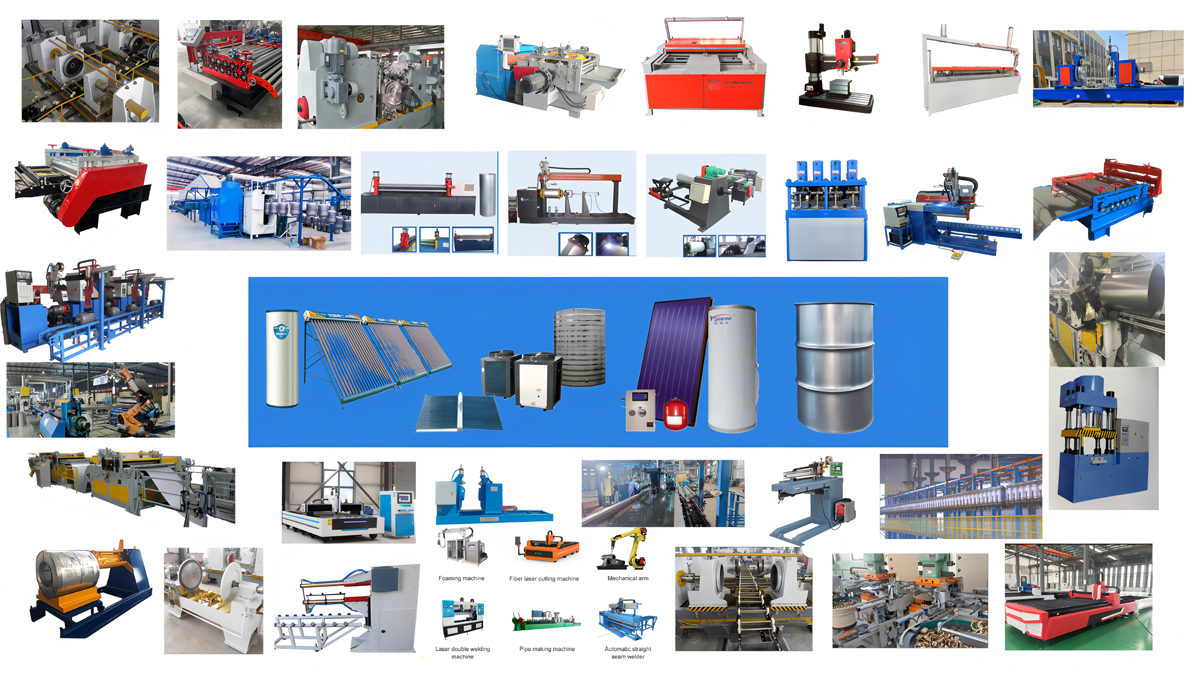
The plate rolling machine is a key forming piece of equipment in a Steel Drum Production Line. It is mainly used to process flat steel plates into cylindrical drum bodies through multi-roll rolling, providing a foundation for subsequent processes such as longitudinal seam welding, flanging, and sealing. This equipment is suitable for the production of 200L steel drums, chemical drums, oil drums, and various metal packaging containers, and can be customized according to different drum diameters, plate thicknesses, and production speeds. The plate rolling machine adopts a high-strength frame structure, precision forming rollers, and a stable transmission system to ensure accurate roundness and good seam matching after rolling. The equipment can be equipped with automatic feeding, hydraulic adjustment, and PLC control functions to achieve continuous and high-efficiency production. It typically applies to steel plate thicknesses of approximately 0.8–1.5mm. The working width and rolling diameter can be adjusted according to customer needs. It features high forming accuracy, stable operation, simple operation, and convenient maintenance. It can be linked with other equipment in the steel drum production line to achieve automated production.


I was walking through a steel drum factory a while back, watching the line run, when I saw something that made me stop.
The rolling machine was feeding sheets through, but the cylinders coming out weren't quite round. They had a slight flat
spot on one side, and the edges weren't meeting properly. The operator shrugged and said, "It's close enough. The welder
will fix it." I've been in this business long enough to know that a welder can't fix a bad cylinder. It can only weld what's there.
And what was there was a drum body that was never going to be perfectly round.
Here's the thing about steel drum production that a lot of people miss: the rolling machine—sometimes called a curler or
plate bender—is the first machine that actually shapes the steel into a drum body. If it does its job right, the rest of the line
has a fighting chance. If it doesn't, you're fighting an uphill battle all the way to the seam.
A Steel Drum Rolling Machine is a three-roller plate bending machine. The sheet is fed between the two bottom rollers, which
are driven by a motor and gearbox. The top roller presses down on the sheet, bending it as it passes through. As the sheet
feeds through, it gradually curls into a cylindrical shape. The bottom rollers are driven by a motor through a reducer, and
they're connected by gears to rotate in the same direction. The top roller is adjustable—on some machines manually, on
others with a hydraulic cylinder. And the roundness of your drum depends entirely on how precisely you can control that
top roller position.
When you're choosing a rolling machine for your steel drum line, the first thing to look at is the capacity. For standard
200-liter drums, you'll be working with steel sheets between 0.8mm and 1.5mm thick. A machine with a capacity of
3mm×1600mm or 4mm×2000mm will easily handle your drum sheets. On the high end of the market, some machines can
handle up to 12mm thick material, but for standard steel drums, anything above 2mm capacity is overkill and costs more
than it needs to.
Another factor is the roll diameter and configuration. The machine will have an upper roll and two lower rolls. The upper roll
diameter, along with the distance between the lower rolls, affects the minimum diameter the machine can roll. For steel
drums, this isn't usually a concern, but it's worth checking if you're planning to run smaller drums down the line. Some
modern machines use asymmetrical roll configurations for easier loading and smaller minimum diameters—the upper roll
is usually movable, while the two bottom rolls are fixed.
Here's a practical tip from my experience: if you're setting up a new line, consider a combined rolling-welding station. Some
manufacturers offer an integrated system where the sheet is rolled into a cylinder and then immediately seam-welded in one
continuous flow. This saves floor space, reduces handling, and minimizes the risk of the cylinder springing open before it's
welded.
Also, pay attention to the control system. Older rolling machines use manual handwheel adjustments for the top roller.
Newer ones use hydraulic controls with PLC automation and touchscreen interfaces. The hydraulic system gives you more
precise control and consistent roundness, while the manual system is cheaper and simpler to maintain. If you're running a
high-volume line, the hydraulic system is worth the extra investment.
One more thing: keep the rollers lubricated and inspected. The rolling process puts a lot of stress on the rollers, and they can
develop flat spots or wear unevenly over time. A regular maintenance schedule—checking the roller surface, ensuring the
gear oil is clean and at the right level, and lubricating moving parts—will keep your rolling machine running smoothly and
your cylinders perfectly round for years to come.
Your steel drum rolling machine is the first step in making a drum body. Get it right, and you're building on a solid foundation.
Get it wrong, and you'll be fighting quality issues all the way down the line.


يستخدم هذا الموقع ملفات تعريف الارتباط لضمان حصولك على أفضل تجربة على موقعنا.


 English
 Español
 Pусский
 Français



 هاتف
هاتف