

تفاصيل الاتصال:
+86 17852488518

Product Overview
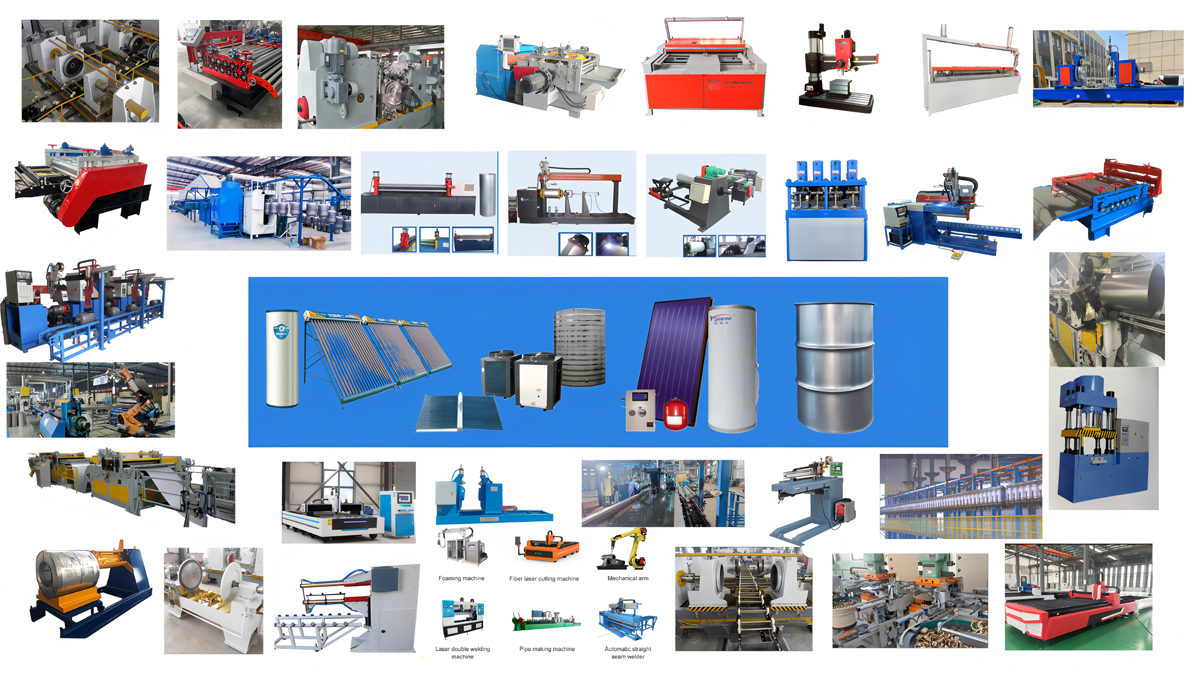
The hydraulic rib-expanding and seam-sealing machine is a crucial forming piece in Steel Drum Production Lines. It's primarily used for pressing reinforcing ribs on the body of 200L steel drums and for forming the drum opening by shrinking the opening. This effectively improves the overall strength, pressure resistance, and appearance quality of the steel drums. The equipment employs a high-performance hydraulic drive system, using specialized molds to precisely expand and seam the ribs on the drum body, ensuring uniform rib depth and stable drum opening dimensions. The machine is equipped with PLC automatic control, a hydraulic adjustment mechanism, and high-precision forming components, allowing for adjustments to processing parameters based on different drum types, plate thicknesses, and production requirements. The equipment is suitable for manufacturing chemical drums, oil drums, paint drums, and various metal packaging drums, featuring high forming accuracy, stable pressure, reliable operation, and ease of use. It typically uses a 380V industrial power supply and can be connected to plate rolling machines, longitudinal seam welding machines, flanging machines, can sealing machines, and conveyor systems to automate and continuously operate the steel drum production process, improving production efficiency and reducing labor costs.


I remember the first time I saw a Steel Drum Production Line struggling to keep up with demand. The bottleneck wasn't the
welder or the seamer—it was the beading and curling stations. Drums had to be moved from one machine to another, anthe handling was slowing everything down. Then someone suggested a combination machine that could do both jobs in one pass. That's when I learned about the hydraulic beading and curling machine.In steel drum production, beading (rolling reinforcing ribs into the drum body) and curling (rolling the edge of the drum or
lid) are two distinct operations that historically required separate machines. But a combination machine does both in one
continuous operation, saving floor space, reducing handling, and improving consistency.
The beading function creates the circumferential ribs that stiffen the drum body and prevent it from crushing under stacking
loads. The machine uses opposed heads that move into the drum body from both ends. A hydraulic cylinder activates
expandable dies inside the drum, pressing outward to form the bead. The motion is controlled by limit switches that signal
the hydraulic valves to shift and change the stroke direction at the correct points. The bead depth is adjustable, and modern
machines use PLC controls for precision. The curling function rolls the edge of the drum body or lid, creating the flange that
allows the double seam to grip. This is done with a separate set of forming heads, and on a combination machine, the
tooling can be swapped in minutes.
When you're considering a hydraulic beading and curling machine, pay attention to several key specs: capacity (material
thickness up to 1.5mm for standard steel drums, with some heavy-duty models handling up to 2.5mm or more); diameter
range (standard machines typically handle 210-300mm or 500-571.5mm for 200L drums); and speed (higher-end machines
can process 8-15 drums per minute).
Make sure the machine has a good hydraulic system with adequate cooling. If you're running a high-volume line, look for a
machine with automatic lubrication—it reduces wear on moving parts and extends the machine's service life. And check how
easy it is to swap tooling. If you're running multiple drum sizes, quick-change tooling is essential to minimize downtime.
The hydraulic beading and curling machine is one of those investments that pays for itself quickly. It eliminates a manual
handling step, reduces floor space, and gives you consistent, high-quality results. For a steel drum factory looking to
optimize its middle-section production, it's not a luxury—it's a necessity.
 RELATED


يستخدم هذا الموقع ملفات تعريف الارتباط لضمان حصولك على أفضل تجربة على موقعنا.


 English
 Español
 Pусский
 Français



 هاتف
هاتف