Industrial Metal Sheet Curving Equipment
Industrial metal sheet curving equipment is a specialized machine designed to bend, roll, arc, and form flat metal sheets into precise curved shapes. It is widely used in industries that require accurate metal forming, such as construction, shipbuilding, aerospace, automotive manufacturing, energy equipment, and heavy machinery production. By applying controlled pressure and mechanical force, this equipment transforms rigid sheets of metal into cylindrical, conical, elliptical, or custom curved profiles without damaging the material structure.The main purpose of industrial metal sheet curving equipment is to improve forming efficiency while maintaining high precision and consistency. Compared with manual bending methods, it offers better repeatability, greater output, and much more stable quality. This makes it especially valuable for large-scale production environments where every finished part must meet strict dimensional requirements. The machine can handle different sheet thicknesses, widths, and material types depending on the specific model and configuration.A typical industrial sheet curving system includes rollers, bending shafts, driving mechanisms, pressure adjustment components, and a control system. The rollers are the core forming elements, as they gradually press the sheet into the desired curvature. Depending on the design, the equipment may use three-roll, four-roll, or multi-roll structures. Each structure has its own advantages in terms of accuracy, efficiency, and ease of operation. Advanced models are often equipped with digital controls, hydraulic assistance, or programmable settings to improve forming precision and reduce operator workload.One important feature of this equipment is its ability to support a wide range of metal materials. It is commonly used with carbon steel, stainless steel, aluminum, copper, and various alloy sheets. Because different metals have different hardness, elasticity, and surface sensitivity, the machine must provide adjustable pressure and curvature settings. This flexibility allows manufacturers to produce parts for many applications, from architectural panels and storage tanks to ventilation ducts, metal enclosures, and structural components.Industrial metal sheet curving equipment also contributes to better material utilization. Its controlled forming process helps reduce waste, minimize deformation, and lower the risk of cracks or surface defects. In addition, modern machines are often designed with safety systems such as emergency stop functions, overload protection, and secure clamping mechanisms. These features help protect both operators and materials during operation.With the development of automation and smart manufacturing, this equipment is becoming more efficient and user-friendly. Some systems now include touchscreen interfaces, automatic positioning, and real-time monitoring to ensure higher productivity and easier maintenance. As industries continue to demand stronger, lighter, and more complex metal structures, industrial metal sheet curving equipment remains an essential tool for modern fabrication. It combines precision, durability, and versatility, making it a key solution for reliable metal forming in many production fields.
نتاج
تصنيف:
-
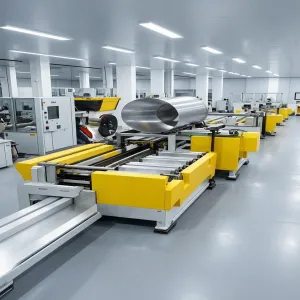
Heavy Duty Steel Plate Rolling Machine
تصنيفها:
خط إنتاج طبل الصلب
المشاهدات:
165
عدد:
وقت الإصدار:
2026-07-21 14:09:25
A plate rolling machine is specialized equipment designed to bend flat metal stock into arcs or cylinders through a rolling process; it is widely used in industries such as pipeline manufacturing, pressure vessel fabrication, steel structure construction, shipbuilding, and wind turbine production. Its operation relies on continuous three-point rolling technology: metal plate is fed between rollers arranged at specific angles. By adjusting the relative positions and rotation of the rollers, continuous, progressive pressure is applied to the plate, inducing plastic deformation to form the desired arc or cylindrical workpiece.
Based on the number and arrangement of rollers, these machines are primarily categorized into three types: symmetrical three-roll, asymmetrical three-roll, and four-roll. The symmetrical three-roll configuration is the most common, featuring a symmetrical layout where the two bottom rollers act as drive rollers to advance the material, while the top roller moves vertically to apply forming pressure; however, this type leaves unrolled flat sections—known as "residual straight edges"—at both ends of the plate. Asymmetrical three-roll machines utilize a side-roll design to pre-bend one end of the plate, significantly reducing the residual straight edge. Four-roll machines are capable of pre-bending both ends of the plate, thereby completely eliminating residual straight edges and allowing the rolling process to be completed in a single setup, though they feature a more complex structure and higher costs.
أخبار
تصنيف:
لا توجد نتائج بحث!
حالة
تصنيف:
لا توجد نتائج بحث!
فيديو
تصنيف:
لا توجد نتائج بحث!
تحميل
تصنيف:
لا توجد نتائج بحث!
تجنيد
تصنيف:
لا توجد نتائج بحث!
المنتجات الموصى بها





 English
 Español
 Pусский
 Français



 هاتف
هاتف